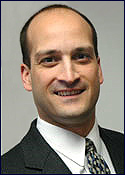
Good morning. My name is John Tonello. Thank you for inviting me to speak to you today.
When my friend Bob Butcher first called to invite me to speak to you, the Elmira mayoral primary was still more than six weeks away and this meeting was originally set for the day after, September 14.
Of course, as a crowd-hungry campaigner, I immediately agreed to come, but then I thought, "What does Bob know that I don't know?" I mean, what will the underdog have to say on the morning after?
I sent Bob an e-mail and asked him, "Do you have a back-up, too?" He said, "No, just you."
No pressure.
I mean, I know Bob's a bright guy, but clairvoyant? No way. He just doesn't look the part.
I've since changed my mind. I'm thinking of asking him to be part of my senior campaign staff.
I'm here this morning to share with you a little about my experience so far in my campaign for mayor. I'm not here to campaign or bore you with my stand on various issues, though, I'm happy to answer any questions you have about issues later. But for now, I want to share with you a little of what we've learned so far.
Just as way of some background, I have never run for public office before. A year ago, I was like most voters -- interested in politics, but mostly detached from the political process. I campaigned for Sam Barend for Congress, but for the most part I was an interested observer in most of the races taking place last fall.
What made me get off my couch and into a race like this was a sense of frustration, really. My neighbors and friends and I talked a lot about what we thought was right and wrong about the city, the state, the federal government, and the common theme was frustration.
We didn't set out to blame anyone; we just thought that people were ready for something -- and someone -- entirely new. Our idea was to focus not on the past, but on the future. To avoid blame, and pursue a positive vision of what-comes-next. On May 19, I announced my plan to run at a press conference in Wisner Park.
I can only speak for myself, of course, but as a newcomer to this sort of thing, in the four months since then, many things struck me as interesting or downright shocking. For example:
Interesting: "Dog bites man" is still front page news. Yes, a German Shepherd bit my arm a couple times while I was going door-to-door, but as one of my journalism professors once told me, it's really only news if the man, not the dog, is doing the biting.
Shocking: It's harder than ever to get people to vote -- even when local, state and national issues are affecting their lives.
For those of you who haven't followed the Elmira mayor's race closely, here are the raw numbers. About 915 Democrats showed up to vote. I received 515 votes to Dan Royle's 400. Combined, we were able to draw out just 16 percent of the city's registered Democrats.
The more hotly contested Republican primary for sheriff drew a slightly larger percentage of voters, about 6,200 countywide or about 27 percent of registered Republicans.
The numbers might seem low, but consider this: In the city, 80 percent of eligible voters don't vote in any election in any year because they're not registered. Dan and I split 16 percent of 20 percent. It's incredible, really.
As a former newspaper reporter, numbers like these interest me because they describe people and human behavior. They describe trends and priorities. They paint a picture of American democracy.
It's not pretty.
I knew going into this race that engaging voters would be a challenge. In fact, it's been 22 years since a Democratic primary for mayor in Elmira, so we had no idea how many people would actually turn out. In the end, about 40 percent of the Democrats who voted in the last mayoral election voted last Tuesday. That doesn't sound so bad, but it still stinks.
But I'm not one to blame voters. That's too easy. I believe the problem is more complicated than that.
Part of problem, I believe, is the lack of primaries themselves. Twenty-two years is a generation and, to me, that's way too long since voters had a real choice. That lack of open debate of ideas and different perspectives leads quickly to leaders self-selecting their successors. It also pushes voters further from the process. In the end, it leads to hard feelings because people forget how to disagree without becoming disagreeable.
Ultimately, it leads to low voter turnout because people come to realize that they're really just rubberstamping party choices. Most people I talk to tell me party doesn't matter in local races, that they vote for the person. Given that, it's little wonder people fail to show up. They've been marginalized and they know it.
That must change. We must learn again to discuss ideas openly, to rely less on nice personalities and more on sound arguments. We must learn to say, "I disagree," and still be able to shake hands or lift a beer.
That's half the reason I took on the challenge of running for office. I truly believe that in order to get things done -- to create a business-friendly city, an atmosphere for job growth, safer neighborhoods -- we need to engage people again. We need to show that open debate is positive, that participation -- real participation -- can happen and it has its own rewards.
That means we have to change some fundamental ideas about how government works. And we have to model that change, not just talk about it. I'm very pleased when people tell me that my campaign has shown that change can happen. That energetic people with no campaign experience can win elections and shape the debate.
Time will tell if the approach that led to our success in the primary will translate into success in November -- I'll have to ask Bob about that -- but I believe at the very least it will start us down the path toward positive, open debate. We all win when that happens.
The thing is, I just don't see any downside to getting people talking again. I see no downside to inviting everyone to join in. Democracy thrives on that.
It does put new demands on our public officials, though, because it demands that our leaders be willing to listen to differing opinions, seek out different points of view, act on that input, and allow citizens to see the successes they help bring about. I hope, in some small way, we've begun that.
Thank you very much for your time this morning.